

a whole lot of people have been asking me how to get into AI, or how to learn deep learning in 2026.
I was about to update the usual advice I hand out, then I stopped and realized it would be soooooo much more useful to bring in other researchers opinion into the mix.
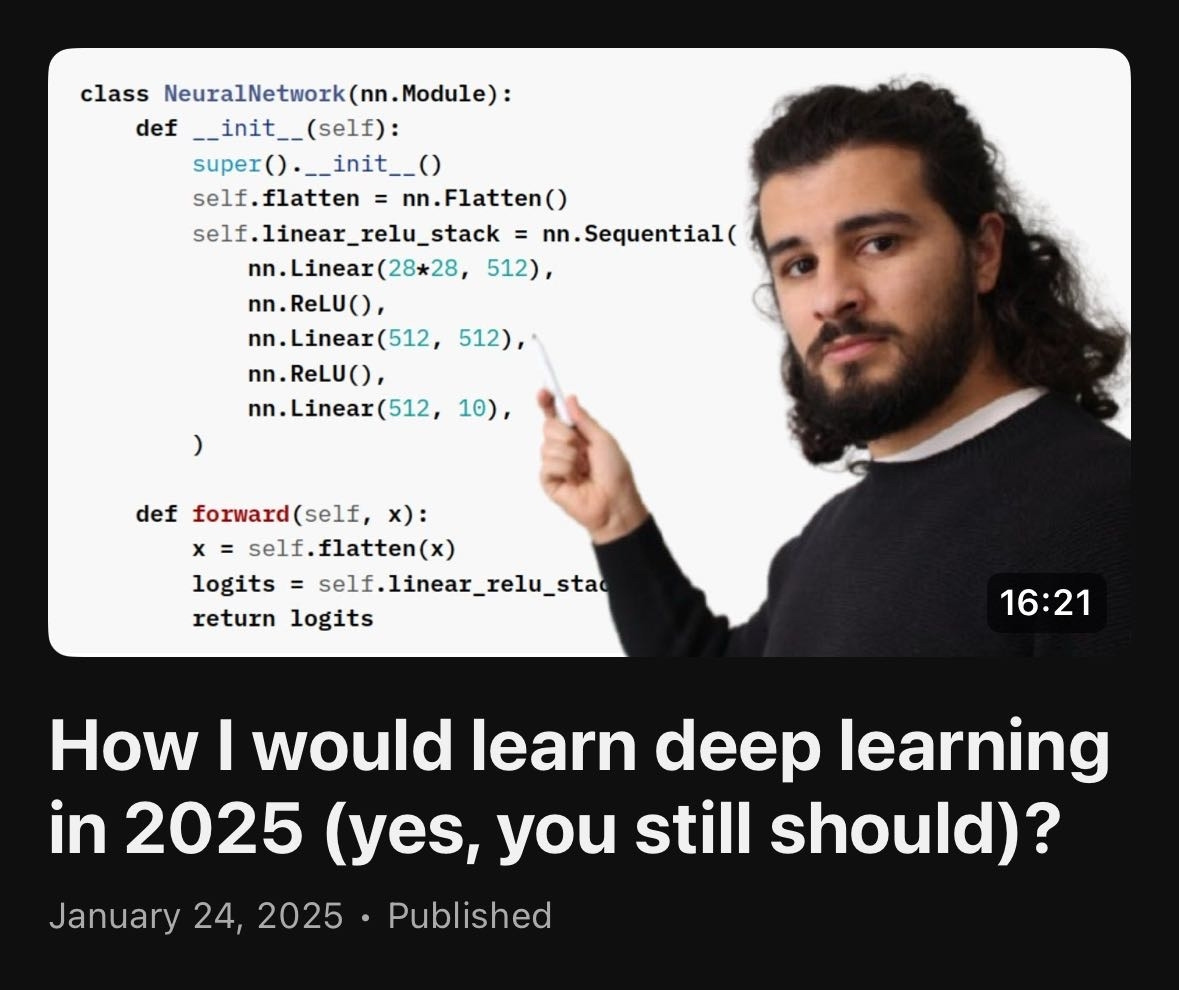
so today’s researcher is the one and only Mandy Lu, and she is like the perfect person to listen to on this because her resume is almost unreal:
dual bachelor’s in math and computer science + a master’s in AI at Stanford, where she did research in the legendary Fei-Fei Li’s Vision Lab.
she built computer vision systems to assess Parkinson’s disease severity from video, published at CVPR and MICCAI, and has a Nature Machine Intelligence paper + a U.S. patent to her name: check out her google scholar.
she was also at google research (now part of deepmind) where she worked on AI for healthcare, including the diabetic retinopathy detection model that has now supported over 600,000 eye screenings in clinics around the world.
she also also worked on Earth and climate AI, think flood and agriculture prediction, and brought some of the first AI features to google scholar.
before all that she did a stint at Apple on the Memories feature, the one that stitches your photos into those little cinematic montages my kids absolutely love.
and at NVIDIA, she wrote GPU drivers for the Jetson TX2, the tiny embedded chip powering a whole lot of robots out there.
fun extra detail to fund her stanford tuition back in the days, she TA’d more than 10 AI and CS courses there, including CS224N (NLP) and CS231N (computer vision, with Fei-Fei Li herself). TEN!
mandy has basically touched every corner of the ecosystem: research and engineering, academia and industry. and now she’s back at stanford doing a PhD in applied math, working on AI for physical systems!
so I asked her exactly one question: “How would YOU actually learn AI if you were a beginner in 2026?” and got nice 5 step answer.
before we dive into it shout-out to scrimba, this newsletter’s sponsor
if you’ve been thinking about taking your first step into AI: you most likely don’t need to go deep on the research side as a beginner. frontier models are already absurdly capable, and most projects don’t require you to understand every little detail under the hood.
what you need first are the practical, programmatic skills to use these models and build useful things for you and the people you want to help.
that’s exactly what scrimba provided, and it’s why I’m happy to have them sponsoring this newsletter.
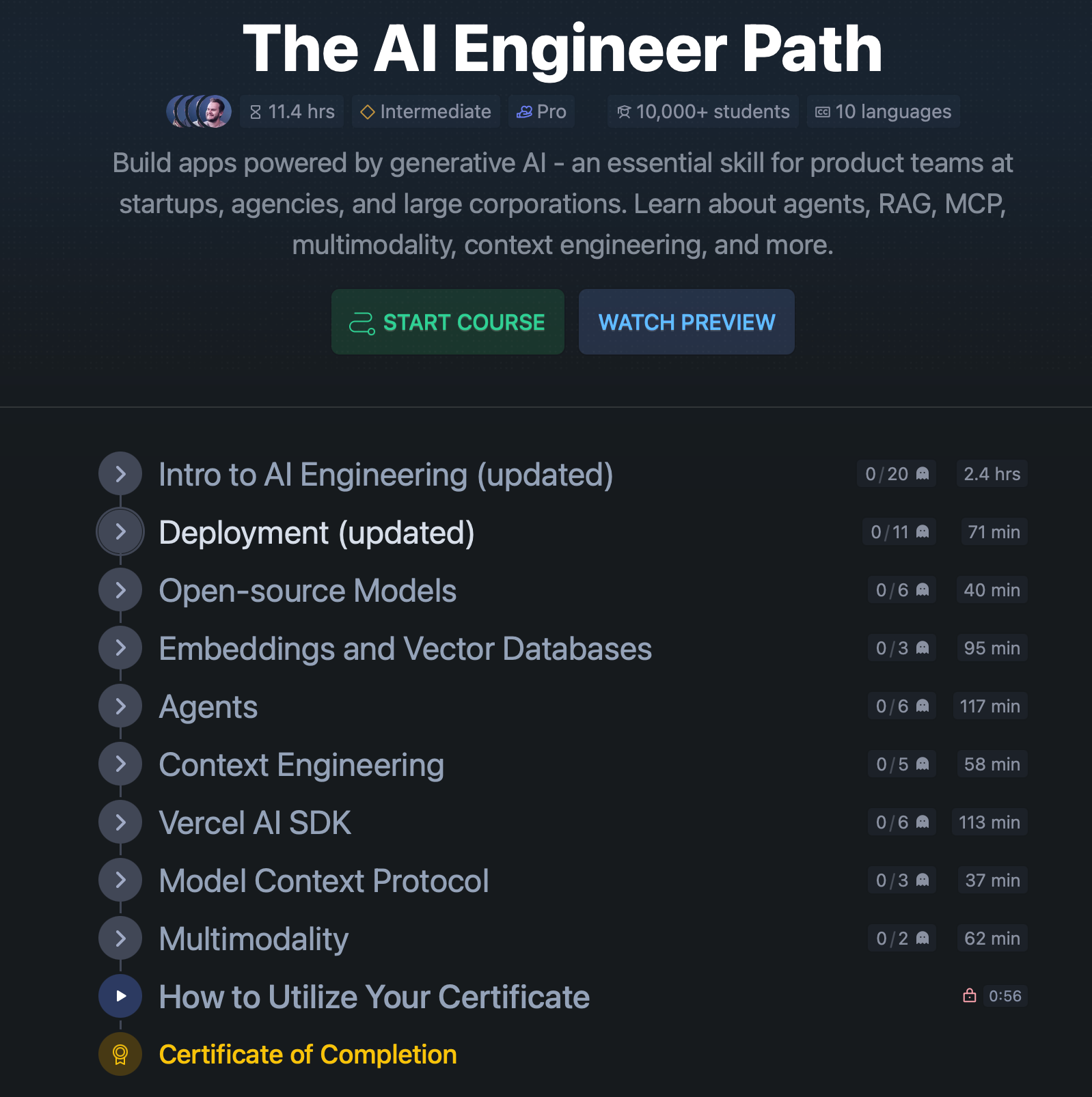
their 7-hour AI Engineering course has everything in one place: you build RAG systems and agents right inside the browser, with editable code, slides and genuinely engaging teachers.
as a beginner, you wouldn’t believe how much it matters to have everything on one screen instead of doing random woo woo just to get the basics running.
use my link for 20% off the full course library, or just check out their massive free library of content and mega thanks to scrimba shout out to my man dan over there love you boss.
mandy’s playbook for learning AI in 2026
I distilled our whole conversation down to five principles so this is easy to digest for you.
for the whole experience of hearing mandy voice beaming with light and her joyful demeanour check out the full video right here:
1. pick the end goal before the curriculum
mandy’s first move is figuring a target. a researcher-type role, a software engineering role, or a ML engineer / research engineer roles all demand very different skill sets, and the learning paths barely overlap.
“not all learning for AI roles is the same. having that clear goal in mind is really helpful.”
If you conflate them, you end up studying like a researcher to land an engineering job (or vice versa) and wondering why nothing is clicking during the interview.
decide first where you’re going first, then build the matching skill tree.
2. find people to mimic
once you know the destination, work backwards from the people already standing there. look for people who are very successful at doing the exact thing you want to do, and reverse-engineer their background: what skills enabled them to pull it off? a lot of them have blog posts, or they post constantly on socials. learn from that, or straight up reach out and ask.
![PsBattle: Jared looking out the window. [Silicon Valley, S03E10] : r/photoshopbattles](https://substackcdn.com/image/fetch/$s_!aj_v!,f_auto,q_auto:good,fl_progressive:steep/https%3A%2F%2Fsubstack-post-media.s3.amazonaws.com%2Fpublic%2Fimages%2F9d939929-3f4a-4bf3-9549-399e9099128c_640x648.png "PsBattle: Jared looking out the window. [Silicon Valley, S03E10] : r/photoshopbattles")
the reasoning for this is pretty intuitive, here let me show you.
close your eyes and dig deep into your cortex for your earliest memory of doing something novel for the first time. it’s maybe going biking for the first time with your dad on a cloudy november morning or going to a swimming lesson with your mom in this public pool right next to your house.
at some point when you are young you have the reflex to just sit and look at other for a while, it’s maybe your parent or that instructor that had this beautiful cheerful smile.
but you stopped, you sat hunched back in your wet swimsuit and you just looked at what they were doing which felt right.
and the next thing you did when it was your turn to move around in the pool is to imitate crudely the movements you saw.

ultimately through refinement and going through the motion yourself you understood in your little young heart how to get there.
that’s what this is about.
surround yourself with these folks that are doing what you care about. find the communities of people interested by the same and just sit and look.
3. learn by doing
mandy describes herself as project-motivated:
“what do I want to build? What kind of system? And then I go from there.”
diving into a real project is muuuuuch better than passively consuming content.
doing is what exposes what you actually don’t know and what feels off.
at some point if you get that lingering feeling that something is off over and over again you should…
4. watch out for the “fundamentals gap”
this one comes straight from mandy TAing 10+ stanford AI courses. there is a very specific failure mode she kept seeing:
“If you keep reading content and it’s not sinking in, that might be a sign there are some fundamentals you should go back on. It’s not a lot, but it is really important.”
that feeling is a signal that there is something that you should understand that has stayed in the background for way too long.
the path isn’t linear btw, everybody has gaps, and you can only discover yours by engaging with content slightly too hard for you, then going back to patch what’s missing.
even senior researchers publish research with “it just worked my guy I have deadlines and this is pushed for later work”.
don’t be too hard on yourself for not getting everything 100% because nobody understands 100% of it.
5. the main pillars worth checking like right now
ok, so luckily for us mandy already has a few pillar you should put a bit of thought into from the get go:
linear algebra, solid enough that matrix manipulations feel comfortable instead of scary.
probability theory, enough to know what maximum likelihood is and why it shows up everywhere.
a bit of optimization.
some familiarity with experimental design always help.
mandy is breaking these exact pillars down on her own substack btw. you can start with Why study math? Is it even useful? and then work through Math You Can Use: Linear Algebra Foundations (Part 1).
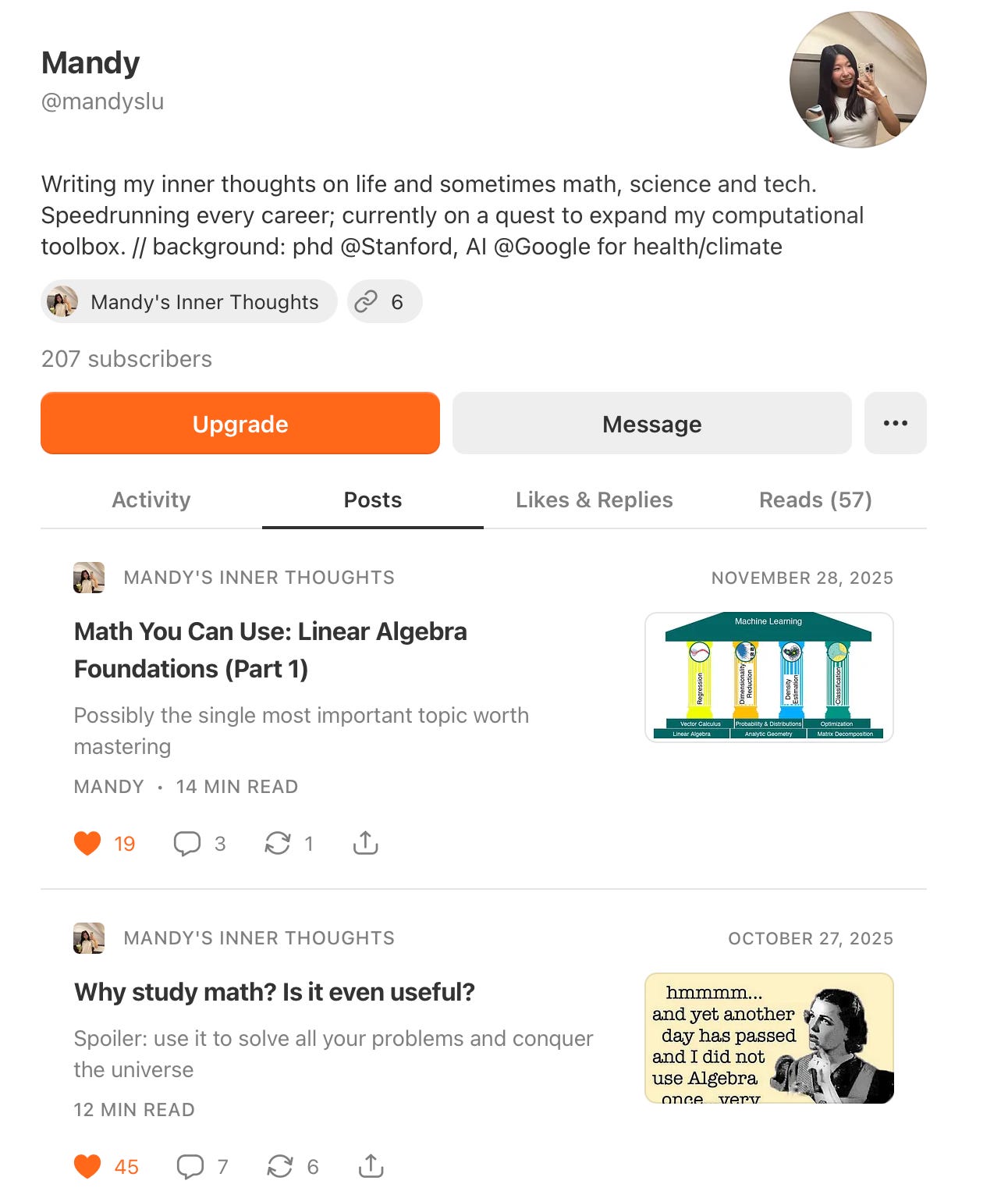
bonus: what she’s building right now
let’s have a quick peek at mandy current research while we are at it, because the direction is cool: AI for physics.
mandy is building highly accurate AI models of water systems. think digital twins of aquifers. california agriculture has over-drafted a lot of these underground water systems, and managing them sustainably requires accurate, real-time predictions. The traditional tools (numerical methods like finite difference or finite volume schemes) are computationally brutal to run, so her work uses AI surrogate models, plus probabilistic forecasting techniques borrowed from weather prediction, to get there faster.
keep it up queen
your immediate next steps
alright, I hope you got something out of the interview. your next move is two-fold:
if you’re just getting your feet wet in AI engineering, check out scrimba. I’m super biased here but I love the app.
if you want to follow Mandy’s path, read what she writes on her Substack, and follow her on twitter where she has just great educational and motivational take.
have a great day my guys! 🌹